New Feature
Introducing Research Objectives: Focused Analysis for Decision-Grade Research
—

Aaron Cannon
Introducing Research Objectives: Focused Analysis for Decision-Grade Research
Outset’s AI-driven analysis already delivers what would have been unimaginable just a few years ago.
It synthesizes hundreds of interviews in minutes, surfaces patterns at scale, and gives research teams unprecedented depth and speed.
As research programs mature and stakes increase, the next challenge isn’t more power — it’s focus.
Senior research teams don’t just want comprehensive insights. They want insights that are clearly aligned to the questions a study is meant to answer and the decisions it’s designed to inform.
That’s why we built Research Objectives.
The Opportunity: Aligning Insight to Intent
Experienced researchers begin every study with a clear point of view:
What decisions are at stake
What risks need validation
What success or failure would look like
Outset’s AI already surfaces rich, high-quality insights across interviews. Research Objectives build on that strength by making researcher intent explicit — so synthesis aligns more directly to the goals behind the study.
This isn’t about changing the depth of analysis.
It’s about ensuring that depth is applied in the right direction.
Research Objectives: Direction for Powerful Analysis
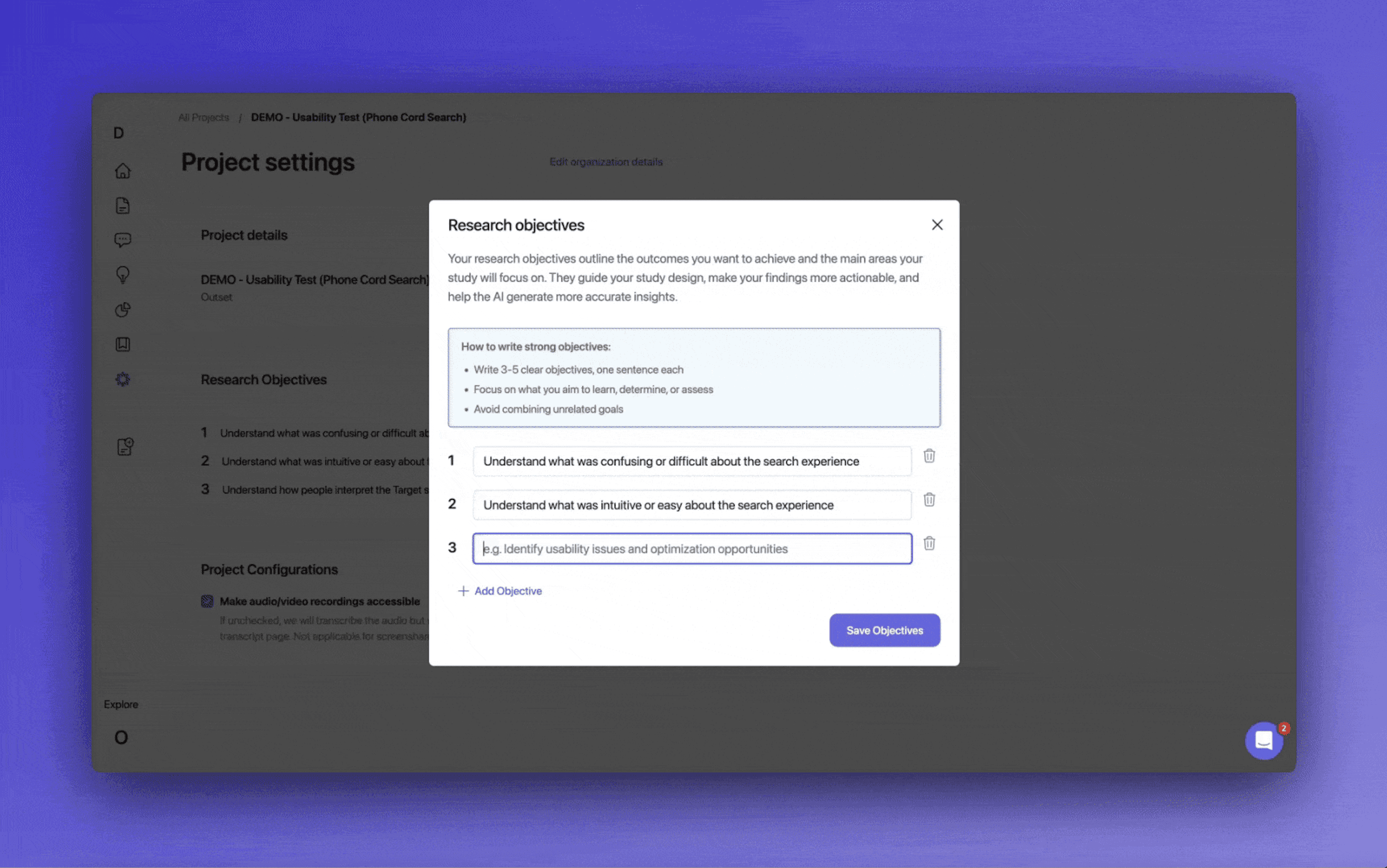
Research Objectives allow researchers to explicitly define what they’re trying to learn and use that intent to focus Outset’s existing analysis capabilities.
By capturing structured research objectives:
Interviews are synthesized with clear directional context
Key takeaways are framed around research goals
Highlights and evidence are prioritized based on relevance to decisions
The analysis doesn’t lose rigor or breadth — it becomes more precise and relevant.
How It Works
Researchers can add structured objectives:
At project creation
Or anytime from the Insights page
These objectives are treated as inputs to the analysis layer, guiding:
How insights are summarized
What evidence is surfaced
How takeaways are framed
The Insights page evolves from a comprehensive view of findings into a more decision-oriented synthesis — without sacrificing analytical richness.
Why This Matters for Research Teams
Faster alignment
Insights map directly to the questions that drive stakeholder consensus.
Greater confidence
Every takeaway is grounded in a clear research objective.
Less downstream work
Fewer cycles spent reframing, restructuring, or validating insights after the fact.
Research Objectives don’t replace researcher judgment—they give Outset the same context a trusted research partner would already have.
Precision at Scale
AI-moderated interviews unlocked scale.
AI-driven synthesis unlocked speed.
Research Objectives unlock focus.
Interested in learning more? Book a personalized demo today!
Book Demo
About the author
Aaron Cannon
CEO - Outset
Aaron is the co-founder and CEO of Outset, where he’s leading the development of the world’s first agent-led research platform powered by AI-moderated interviews. He brings over a decade of experience in product strategy and leadership from roles at Tesla, Triplebyte, and Deloitte, with a passion for building tools that bridge design, business, and user research. Aaron studied economics and entrepreneurial leadership at Tufts University and continues to mentor young innovators.