What AI-moderated diary study software is (and how to choose it)
Jun 3, 2026

What AI-moderated diary study software is (and how to choose it)
Research teams increasingly need to understand how behavior and attitudes change over time. According to McKinsey's 2025 global survey, 88% of organizations report using AI in at least one business function, up from 78% a year earlier. That momentum is reaching research operations, where AI-moderated diary study software is changing how teams capture longitudinal insights.
This guide explains what AI-moderated diary studies are, why they matter, how the software works, and what to look for when evaluating tools.
What is an AI-moderated diary study?
An AI-moderated diary study is a longitudinal research method where an AI interviewer conducts a live, adaptive conversation with each participant during every round of the study. Instead of participants filling out static forms, they answer questions that respond to what they share in real time.
A diary study asks participants to log their experiences over days or weeks, capturing behavior in context. As Nielsen Norman Group defines it, a diary study is "a qualitative user research method used to collect insights about user behaviors, activities, and experiences over time and in context."
AI moderation adds a layer of depth. Rather than leaving participants with a set of fixed questions, an AI moderator adapts the conversation based on each answer. If a response is vague, the AI probes deeper before moving on. The result is research that feels like an interview, not a survey.
Key point: Traditional diary tools treat each entry as a form submission. AI-moderated diary software treats each round as a real conversation.
Why teams run diary studies
Diary studies capture behavior as it happens, not as people remember it later. This matters because memory is unreliable.
According to a 2022 study of nearly 54,000 consumers, 38% of consumers inaccurately recall their online behaviors. That gap between what people say and what they actually do—often called the say-do gap—is one of the biggest threats to research validity.
Longitudinal methods reduce that risk by collecting data in the moment, across multiple touchpoints. Teams use diary studies for:
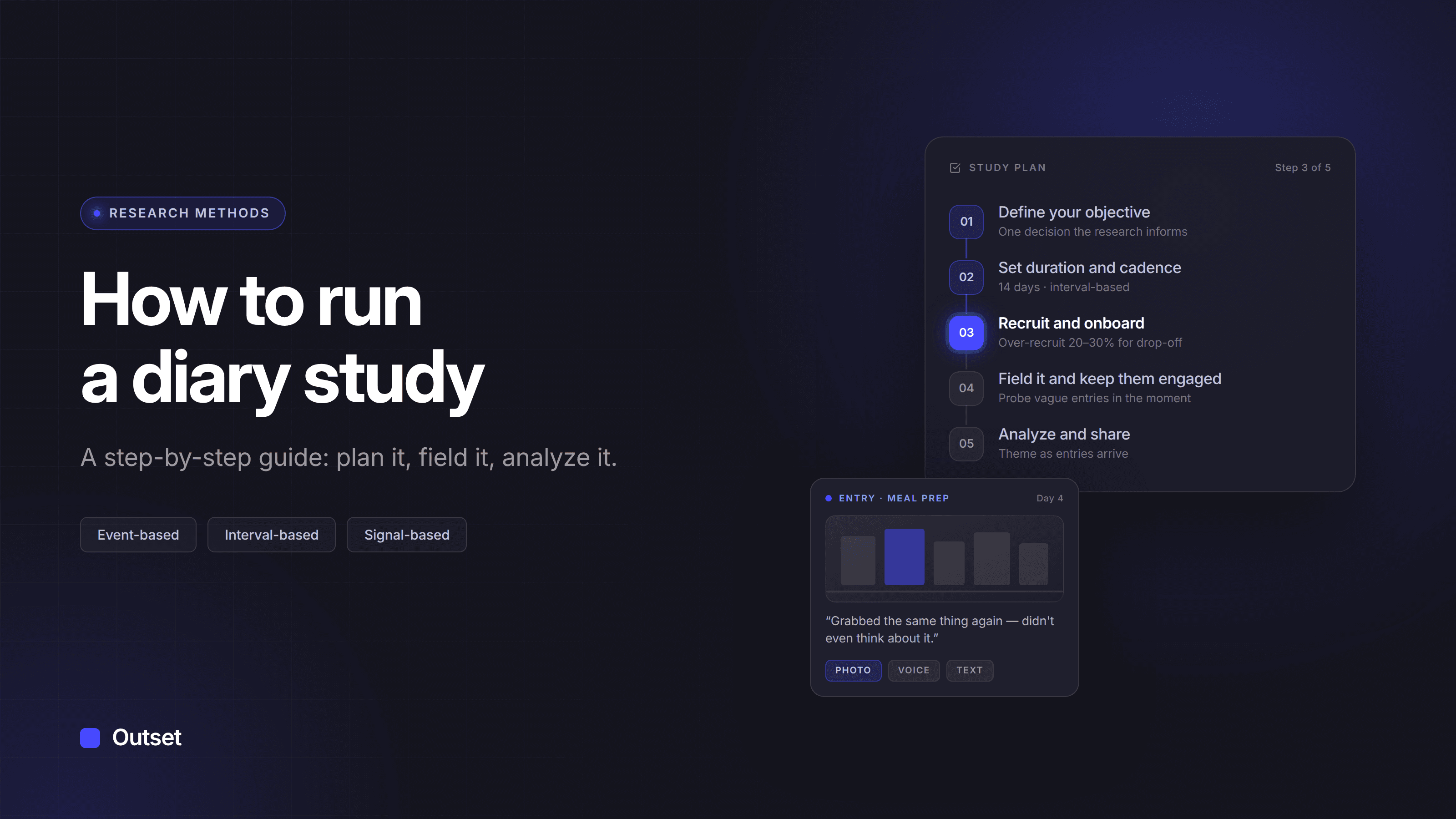
Product adoption over time: Track how new users learn a product across their first two weeks
CPG usage occasions: Document when, where, and why consumers reach for a product in real life
Habit and attitude change: Observe shifts in behavior during a campaign, trial, or lifestyle intervention
The method shines when context and timing matter. A one-time interview asks people to recall. A diary study asks them to report in real time.
How AI-moderated diary study software works
AI-moderated diary software automates the moderator's role in every round, from probing follow-up questions to generating synthesis. For a detailed walkthrough, see how AI moderation works.
The workflow starts with setup: a researcher defines the study guide, objectives, and the number of rounds. Participants receive automated invitations to each round. When they respond, the AI moderator runs a live session.
Live conversation in every round
Each diary round is a real-time conversation between the participant and an AI moderator. The moderator follows the researcher's guide but adapts to what the participant says.
If an answer is vague—"it was fine"—the AI asks for specifics before the session ends. This happens live, not as an async follow-up queued for later. The depth rivals an in-depth interview, delivered at scale.
This is distinct from entry-level AI assistance. Some diary tools offer per-entry AI prompts or queue follow-ups for later review. AI-moderated interviews treat each round as a live moderated session, with probing that happens within the conversation.
Key point: The differentiator is conversation-level moderation every round, not entry-level prompts.
Synthesis that starts at round one
Every session generates an AI summary the moment it closes. Researchers see themes, quotes, and topline insights without manual tagging.
This contrasts with tools that treat synthesis as a final step—or charge for it as an add-on. With per-session synthesis, analysis starts at round one. Teams can identify emerging patterns mid-study and adjust accordingly.
Seeing what participants do, not just what they say
Participants can share photos, screens, and real-world environments. Visual Intelligence lets the AI moderator see what participants show and ask follow-up questions about it.
This ties the say-do gap directly to the diary context. A participant might describe a cluttered workspace, but a photo lets the moderator probe specifics: "I see three products on your desk—which one do you reach for first?"
Key point: Visual context closes the gap between reported behavior and actual behavior.
What to look for in AI-moderated diary study software
Choosing a diary tool requires evaluating whether it fits your research rigor, not just whether it can run a study. Understanding when to use AI-moderated research helps teams match methods to objectives.
Here is a checklist for evaluating tools:
Depth of AI moderation each round: Does the AI conduct a live conversation, or only offer entry-level prompts?
Per-session synthesis: Does every round generate an automatic summary, or is synthesis manual or a paid add-on?
Cohort tracking and scheduling: Can you manage participant cohorts, automate round invites, and send reminders natively?
Recruitment options: Does the platform integrate with participant sources, or do you manage recruitment separately?
Methodology breadth: Can you run diary studies alongside IDIs, concept tests, and usability studies in one platform?
Enterprise governance: Does it meet SOC 2, GDPR, and HIPAA requirements?
Criterion | Old way | AI-moderated diary software |
|---|---|---|
Each round | Static form, async follow-ups | Live conversation with dynamic probing |
Synthesis | Manual review or paid add-on at study end | Auto-generated summary after every session |
Scheduling | Separate coordination tools | Native cohort tracking, automated invites, reminders |
Platform scope | Diary-only tool, migration for other methods | One platform for diary, IDIs, concept, usability |
Governance | Varies, often limited | SOC 2 Type II, GDPR, HIPAA compliance |
Key point: A professional-grade tool is built for the job, not just the demo. Evaluate for rigor, not surface features.
How Outset approaches AI-moderated diary studies
Outset extends its AI moderation model into longitudinal research. Every diary round is a live AI-moderated conversation with probing that adapts in real time.
Teams can run automated diary studies alongside IDIs, concept tests, and usability studies—all in one platform. There is no migration required for existing Outset users. Native cohort tracking, round scheduling, automated invites, and participant reminders are built in. Recruitment integrates with Prolific, Respondent, or connected panels.
Per-session synthesis is included at no extra cost. Every session auto-generates insights, topline reports, and themes the moment it closes.
First-party evidence supports the approach. In a 98-participant Outset study, researchers found how participants experience AI interviews: dynamic follow-ups led to a 3.5x increase in total response volume compared to initial answers. Nestlé reported "more than twice as much depth as our next best method" when using AI-moderated research.
At scale, Outset has delivered 500K+ interview hours across 10K+ studies, reaching 1.1B+ participants in 85+ countries and 40+ languages. The platform is SOC 2 Type II, GDPR, and HIPAA compliant, with 99%+ fraud-tagging accuracy. Enterprise teams at Microsoft, HubSpot, and Glassdoor trust it for research programs.
Key point: Outset is the professional-grade choice for teams that need depth, scale, and governance in one platform.
When a diary study is (and isn't) the right method
Diary studies work best when you need to observe change over time, capture behavior in context, or track habits.
Use a diary study when:
You are studying behavior that unfolds across days or weeks (product adoption, habit formation)
Context matters—you need to see where, when, and how behavior happens
You want to reduce recall bias by collecting data in the moment
Consider other methods when:
You need a one-time reaction (concept test or usability session)
The topic requires rapport-heavy, highly improvised conversation
Turnaround time is extremely short
One practical note: diary studies have dropout risk. Participants may lose interest over multiple rounds. Over-recruit and use automated reminders to compensate.
Frequently asked questions
What is a diary study?
A diary study is a qualitative research method where participants log their experiences over days or weeks, capturing behavior in context as it happens.
What is AI-moderated research?
AI-moderated research uses an AI interviewer to conduct and adapt qualitative sessions in real time, following a researcher's guide and probing for depth.
How is AI used in diary studies?
AI moderates each diary round as a live conversation, probes vague answers within the session, and generates an automatic summary when the session closes.
How long should a diary study run?
Study length depends on the behavior being observed. Most run from a few days to several weeks. Habit or attitude tracking may require longer windows.
How do you reduce dropout in a diary study?
Over-recruit participants to account for attrition. Use automated reminders and round scheduling. Keep each round short, conversational, and easy to complete.