How In-Home Usage Testing Works for Consumer Insights
Jun 3, 2026

How In-Home Usage Testing Works for Consumer Insights
A product that scores well in a lab might fail in someone's kitchenA product that scores well in a lab might fail in someone's kitchen—66% of new products fail within two years of launch. In-home usage testing (IHUT) is the market research method that closes that gap—putting real products in real homes for days or weeks to capture how people actually use, store, and live with what you're building.
This guide covers when IHUTs make sense, how to run them, the data collection methods that work, and how AI is changing what's possible in longitudinal product research.
What is in-home usage testing
An in-home usage test (IHUT) is a market research method where real consumers use a product in their natural home environment over a period of days or weeks. You might also hear it called a home use test (HUT) or iHUT—all three terms refer to the same approach.
The basic setup works like this: a company ships a product directly to participants, who then use it the way they normally would in their kitchen, bathroom, or living room. Along the way, participants record their impressions through diaries, surveys, or video logs. Unlike a controlled lab or a mall intercept (often called a central location test), an IHUT captures how a product actually performs during authentic, everyday use.
Why does that matter? A lab can tell you whether a product works. A home test tells you whether it works in someone's life—with their habits, their schedule, and their constraints.
Why in-home usage testing matters for consumer insights
The value of IHUT research comes down to three things:
Real-world context: Lab tests control for variables. Home tests reveal variables—how someone stores a cleaning product under the sink, whether a snack gets finished before it goes stale, or how a skincare routine fits into a morning rush.
Extended feedback: First impressions fade. Longitudinal exposure captures how initial excitement shifts into habitual use or abandonment.
Packaging and instructions: Does the label make sense at 6 a.m.? Is the serving size realistic? Home use surfaces friction that never shows up in a conference room.
Without this kind of feedback, teams are guessing at how products will perform once they leave the shelf.—where only 15% of CPG launches remain viable after 24 months.
When to use in-home usage testing in the product lifecycle
IHUTs fit naturally at several points in product development. Early on, they validate whether a concept translates into something people can actually use. Mid-development, they stress-test formulations or designs before committing to production.
Pre-launch is where IHUTs often deliver the most value—Pre-launch is where IHUTs often deliver the most value—brands using IHUT data report 30–40% fewer post-launch reformulations, confirming that the product, packaging, and messaging work together in real conditions. Post-launch, they support optimization: identifying why repeat purchase rates are lower than expected, or benchmarking against a competitor's offering.
The common thread? IHUTs answer questions that require extended, naturalistic use. If you can get the answer in a single session, a central location test might be faster. If you want to see how behavior evolves over time, home use is the right call.
In-home usage testing vs central location tests and focus groups
Each method answers different questions.
Dimension | In-home usage test | Central location test | Focus group |
|---|---|---|---|
Setting | Participant's home | Controlled facility | Moderated room |
Duration | Days to weeks | Single session | Single session |
Feedback type | Longitudinal, behavioral | Immediate, sensory | Attitudinal, group dynamics |
Best for | Extended use, real-world context | Quick sensory screening | Concept exploration |
Central location tests excel at rapid sensory evaluation—taste, texture, scent—where you want controlled conditions and immediate reactions. Focus groups surface attitudes and group dynamics around a concept. IHUTs fill the gap when you want to understand how a product performs over time, in context, with real usage patterns.
Types of in-home usage tests
Single-exposure product tests
Participants receive a product, use it once or for a short period, and report back. This format works well for first impressions, packaging evaluation, or quick sensory feedback where extended use isn't necessary.
Extended-use product tests
The classic IHUT format: participants use a product over one to four weeks, capturing how perceptions shift with repeated exposure. This is the go-to for durability testing, habit formation, and repeat-purchase intent.
Sequential monadic and comparative tests
Participants test multiple products in sequence or side-by-side. Sequential monadic designs reduce bias by separating exposures; comparative designs let participants directly contrast options. Both are useful for competitive benchmarking or variant testing.
Concept-in-use tests
Participants see the positioning, claims, or packaging alongside the actual product. This format validates whether marketing promises hold up during real use.
How to run an in-home usage test
1. Define the research objective and success criteria
Start with the decision the study will inform. Are you validating a reformulation? Testing packaging clarity? Benchmarking against a competitor? Clear objectives keep the study focused and the analysis actionable.
2. Design the screener and recruit the sample
Screen for category behavior, not just demographics. Someone who buys laundry detergent monthly will give you different feedback than someone who buys quarterly. Panel integrations—like those with Prolific, User Interviews, or Respondent—can accelerate recruitment across geographies.
3. Ship the product and onboard participants
Decide whether to send branded or unbranded product based on your research goals. Provide clear instructions, set expectations for the usage period, and confirm participants understand how to submit feedback.
4. Field the study and capture behavior in real time
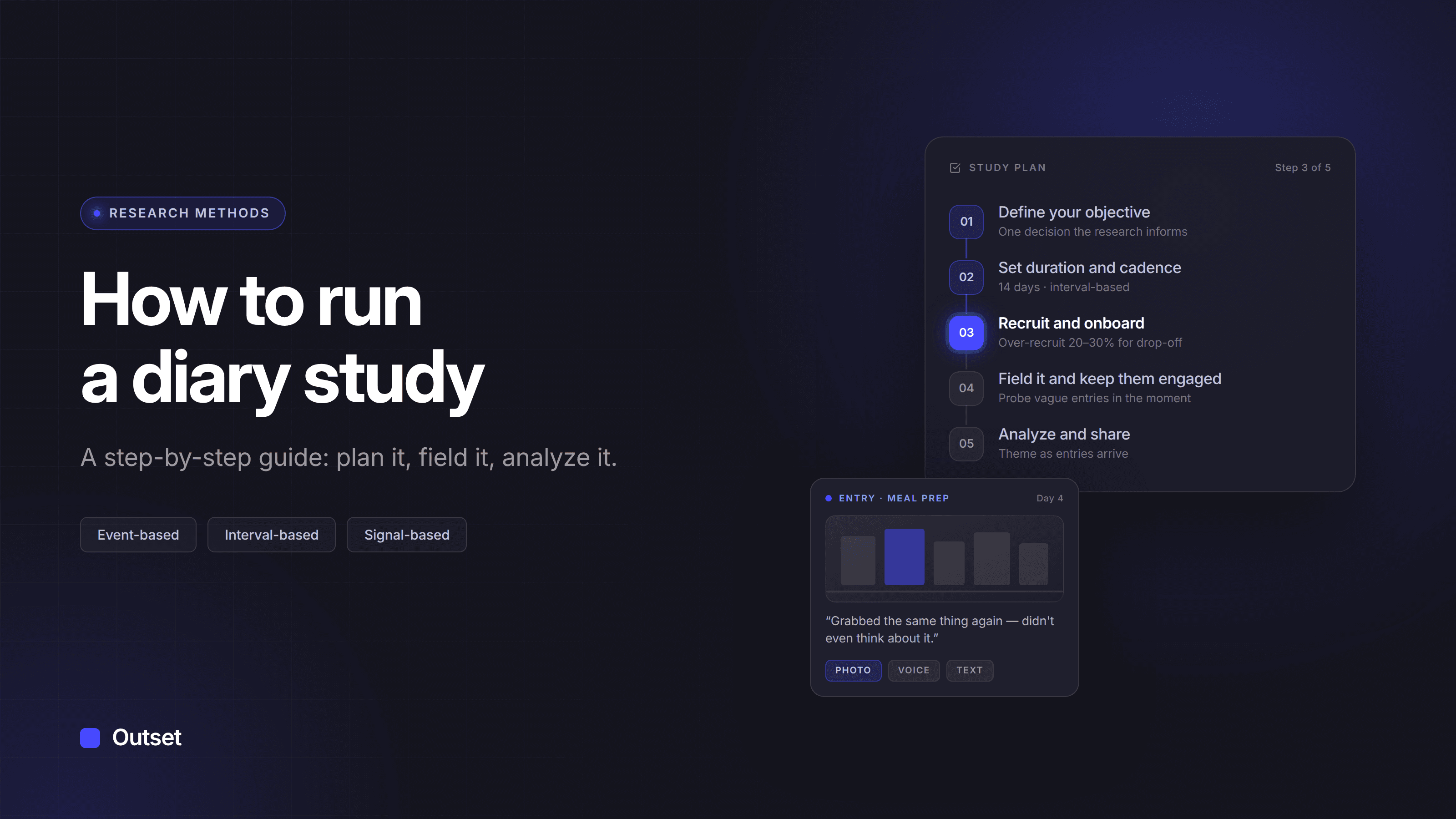
This is the usage phase. Participants use the product over the study period—typically one to four weeks—while completing diaries, surveys, or video logs. The goal is to capture impressions as they happen, not reconstructed memories after the fact.
5. Synthesize findings and deliver decisions
Raw feedback becomes actionable insight through coding, theming, and analysis. Speed matters here: the faster insights reach stakeholders, the sooner they can inform decisions.
Data collection methods for IHUT studies
Structured diaries and surveys
Daily or round-based entries capture impressions over time. Participants typically complete Likert scales, open-ended questions, and task completion logs. The structure ensures consistency; the open-ends surface unexpected themes.
Photo and video uploads
Visual evidence closes the gap between what participants say and what they actually do. Photos of storage locations, videos of usage routines, and images of packaging issues provide context that text alone can't convey.
AI-moderated interviews and diary sessions
Traditional diaries rely on participants to self-report accurately—but vague answers often go unchallenged. AI-moderated sessions change this dynamic: a conversational AI probes on unclear responses in real time, within the session, before the participant moves on. This captures the depth of a moderated interview without requiring a human moderator for every session.
Passive and sensor-based capture
For appliances or connected devices, IoT sensors or wearables can capture usage data automatically. This is an emerging method, but it's increasingly relevant for consumer tech and smart home products.
How AI is modernizing in-home usage testing
The traditional IHUT workflow involves significant manual coordination: scheduling, reminders, follow-up probing, and synthesis. AI is compressing that timeline while improving depth at the same time.
Within-session AI probing: Instead of waiting for a researcher to review diary entries and send follow-up questions, the AI catches vague answers in the moment and asks clarifying questions before the participant moves on.
Automated synthesis: Each session generates an AI summary the moment it closes. Analysis starts at round one, not after the final submission.
Single-platform workflows: Recruitment, interviewing, and analysis happen in one place—no context switching, no data migration, no separate contracts for each capability.
This shift turns IHUT from a slow, coordination-heavy method into something AI consumer research teams can run continuously.
Use cases for IHUT across consumer categories
Food and beverage
Taste over time, preparation habits, packaging convenience, and spoilage or freshness perception. Extended use reveals whether a product earns a spot in the regular rotation.
Personal care and beauty
Skin or hair results over weeks, fragrance longevity, application routines, and packaging usability. For consumer packaged goods teams, first impressions matter less than cumulative results.
Household and cleaning products
Cleaning efficacy in real conditions, scent persistence, and bottle or dispenser performance. Lab tests can't replicate the variety of surfaces and messes in actual homes.
Pet, baby, and family products
Multi-user households introduce complexity. Safety, ease of use, and repeat-purchase intent all depend on how the product fits into family routines.
Small appliances and consumer tech
Setup experience, durability, integration into daily routines, and instruction clarity. Products in this category often require extended use to reveal friction points.
Best practices for running an in-home usage test
Match study duration to the usage cycle
A two-week study makes sense for a daily-use product. A product used weekly might require four to six weeks. Align field time to how long it takes to form habits or deplete the product.
Recruit for category behavior, not just demographics
Screen on actual usage patterns—frequency, brand repertoire, purchase drivers. A heavy category user will notice different things than a light user.
Probe on behavior, not just ratings
A 7 out of 10 rating tells you little. The story behind the rating—why it wasn't an 8, what would make it a 9—is where the insight lives.
Capture visual evidence alongside self-report
Photos and videos close the say-do gap. They show context the participant might not think to articulate: where the product lives, how it's used, what gets ignored.
Build in round-level synthesis from day one
Don't wait until the final round to analyze. Surfacing themes early lets you adjust the study if needed—or escalate findings that can't wait.
What to look for in an IHUT platform
Researcher configurability
The researcher controls the instrument—moderator style, probing depth, guide logic, analysis frameworks. The AI is the researcher's tool, not a replacement for research judgment.
Methodology breadth in one platform
IDIs, diary studies), concept tests, and usability evals without switching tools or contracts. Platform completeness means the research program lives in one place.
Enterprise-grade infrastructure and governance
Multi-layer governance, integrations, data segregation, and compliance (SOC 2 Type II, GDPR, HIPAA). For enterprise teams, these aren't nice-to-haves—they're requirements.
Human partnership and research support
Research experts who design studies, build integrations, and support adoption. Software alone doesn't solve research problems; partnership does.
Run professional-grade IHUTs with Outset
Outset brings AI-moderated depth to in-home usage testing. Every diary round is a live conversation—the AI catches vague answers in the session and probes deeper before the participant moves on. Each session generates an AI summary the moment it closes, so analysis starts immediately.
With Visual Intelligence, the moderator can see packaging, products, and usage context—not just hear about them. Recruitment integrates directly with Prolific, User Interviews, and Respondent, plus access to 1.1B+ participants across 85+ countries. And enterprise infrastructure—SOC 2 Type II, GDPR, HIPAA—means the platform works for teams of five or five hundred.
Frequently asked questions about in-home usage testing
How long does an in-home usage test typically take?
Most studies run one to four weeks, depending on the product's usage cycle and research objectives. Daily-use products often require less time than products used weekly or monthly.
How many participants should an IHUT include?
Sample size depends on segmentation and the depth of qualitative feedback required. Studies range from dozens for deep qualitative work to hundreds for broader validation.
Can in-home usage tests be run internationally?
Yes. Global panels and multilingual AI moderation enable IHUTs across multiple countries and languages simultaneously. Outset supports 40+ languages and recruits from 85+ countries.
Is in-home usage testing qualitative or quantitative research?
IHUTs can be either or both. Many studies blend structured surveys (quant) with open-ended probing or diary entries (qual) to capture both breadth and depth.
What deliverables come out of an in-home usage test?
Typical outputs include topline reports, thematic summaries, highlight reels, and exportable data for further analysis or stakeholder presentations.