Human-moderated vs AI-moderated interviews: when to use each
Jun 3, 2026

Choosing between human-moderated vs AI-moderated interviews is now a routine call for research teams. The right answer depends on the study in front of you. This guide shows you how to make that call, one study at a time.
Human-moderated vs AI-moderated interviews: match the moderator to the study
Use AI-moderated interviews when your research question is defined and you need scale, speed, or many languages. Use human-moderated interviews when the question is still forming, the topic is high-stakes or emotional, or one nuanced thread drives the decision. Most mature research programs use both.
Treat the choice as a per-study decision. Many teams start with a few human-led sessions to learn the problem space, then scale what they learned with AI. That pattern works best when both methods live in one workflow.
What are AI-moderated and human-moderated interviews?
A research moderator is the person, or system, that runs an interview. The moderator asks questions, listens, and asks follow-up questions to get past vague first answers. Those follow-ups are called probing.
In an AI-moderated interview, an AI runs the conversation from a discussion guide the researcher writes. A discussion guide is the list of topics and questions for the study. The AI asks each question, probes when an answer is thin, and then groups responses into themes across all sessions.
In a human-moderated interview, a trained researcher leads the session live. They can improvise, change the order of questions, and build rapport. Rapport is the trust that helps people speak openly.
Some people think of AI moderation as a smart survey. A survey collects fixed answers to fixed questions, while an AI moderator holds a back-and-forth conversation and asks follow-ups based on what each person says. To see the flow step by step, read how an AI-moderated interview works.
The researcher still sets the goals, writes the guide, and decides how deep the AI should probe. The researcher is the expert, and the AI is the instrument.
The core trade-off: scale vs depth
With human moderation, sample size is capped by moderator hours. Each session needs scheduling, a moderator, notes, and review. AI moderation runs many sessions in parallel, so one study can reach dozens or hundreds of people in the same window.
Bigger samples help you judge how common a theme is. They don't make any single conversation deeper. Depth comes from good questions and good probing, whoever asks them.
Small samples can still surface core themes. Saturation is the point where new interviews add little new information. Guest and colleagues studied 60 interviews in 2006, with a similar group of participants and the same questions for everyone.
The Guest saturation study found that "saturation occurred within the first twelve interviews, although basic elements for metathemes were present as early as six interviews." The authors warn this doesn't apply to highly exploratory interviews or very mixed groups. Treat 12 as a planning reference for structured studies, never a universal rule.
Scale matters most when you compare segments, markets, or concepts, because each group needs its own sample. Outset's answer to depth at scale is configurable probing, where researchers set how far the AI digs.
Strengths and limits of each method
Every research moderator, human or AI, comes with trade-offs. The sections below cover where each one does its best work and where it tends to break down.
Where AI moderation is strong and where it falls short
AI moderation works best when you know what you want to learn and need many conversations to learn it. Outset runs AI-moderated interviews at scale across video, voice, and text. Researchers can allow up to 10 layered follow-ups per question with Abyss mode.
Consistency: Every participant hears the same core questions in the same tone, which makes comparisons cleaner.
Parallel scale: Sessions run at the same time, so sample size isn't limited by one moderator's calendar.
Language coverage: One guide can run in 40+ languages without hiring a moderator for each market.
Async flexibility: Participants join when it suits them, across time zones, without a live booking.
Instant synthesis: Themes, quotes, and summaries are ready as sessions finish, so analysis starts right away.
The limits are real, and early research names them. In the NN/g AI interviewer study, "Only 3 (out of 10) participants agreed with the statement 'The conversation felt natural'." That study had 10 participants, tested 2 tools, and ran in early 2026.
Unexpected threads: AI follows a guide well but is weaker at chasing a surprising idea nobody planned for.
Natural feel: Some participants find the conversation stiff, which can limit rapport and openness.
Guide dependence: A vague or leading guide produces vague or leading data, repeated across every session.
Where human moderation is strong and where it falls short
A skilled human moderator can read the room. That skill matters most when the conversation can't be scripted.
Improvisation: A person can drop a question, reorder the guide, or follow a surprising comment on the spot.
Rapport: Eye contact, tone, and small talk help people relax and share personal stories.
Sensitive topics: A human can notice distress, slow down, or pause the session when care is needed.
Credibility with experts: Senior executives and specialists often expect a peer who knows their field.
Human moderation has its own costs. Most of them come from the fact that one person can only be in one session at a time.
Capacity: Each session takes a researcher's time to prepare, run, and review.
Scheduling: Booking live sessions across time zones can take longer than running them.
Moderator drift: Moderators slowly change how they ask questions from one session to the next.
Leading questions: A tired or invested moderator may hint at the answer they hope to hear.
Slow synthesis: Manual notes, tagging, and coding can take longer than the interviews themselves.
What the research says about AI vs human moderation
Research on AI-moderated interviews is early. Most studies are small, and several are preprints, which are papers shared before peer review.
An AI vs human moderation preprint found that AI "matches human moderation in depth, covers more themes." The same paper also found that "participants sound more emotionally engaged when speaking to a live human." It studied 317 people, but only 24 were in the human-moderated group.
A randomized AI interview experiment found that AI "elicited roughly 65 percent more respondent text per interview." That preprint tested 41 university students in text chat, and the human interviewers were trained non-experts. Its authors caution that the results don't show AI can replace expert human interviewers.
Findings on response volume are mixed. In the first preprint, people spoke more to human moderators. In the second, AI drew more text per interview, though humans got longer individual answers, a gap that wasn't statistically significant.
The setups explain some of that gap. One study used voice and the other used chat, and interviewer skill differed too.
Outset's own research points the same way on probing. In a March 2024 Outset study of 98 US participants, dynamic AI follow-ups led to a 3.5x increase in total response volume. It was an internal study, not peer-reviewed, and you can read how participants opened up to AI probing.
Adoption is still early, at least in UX. In the NN/g 2026 AI practitioner survey, "Only 11% of respondents reported using AI interviewers." That survey covered 521 UX practitioners in August and September 2026, so it doesn't speak for market researchers.
The fair read is this. AI moderation looks strong for structured work and breadth, while humans keep an edge in emotional engagement. No study yet compares AI with expert human moderators in exploratory interviews.
When to use AI-moderated interviews
AI moderation fits studies where you can write the key questions ahead of time. These use cases are a strong match.
Defined product feedback: Ask users about a feature, flow, or release once you know which questions matter.
Concept and creative testing: Show ideas, ads, or packaging to many people and probe why each one lands or misses.
Churn and win-loss: Learn why customers left (churn) or why deals were won or lost, without booking dozens of calls.
Multilingual programs: Run one guide across markets and languages, then compare themes side by side.
Continuous discovery: Keep customer conversations running every week instead of saving them for one big study a quarter.
Small teams with big backlogs: Give a lean research team the capacity to answer more questions without adding headcount.
Concept work is one of the clearest fits, because you need both reactions and reasons. See how Outset handles concept testing at survey scale.
Customer results show what this looks like in practice. WeightWatchers ran 100 AI-moderated interviews in 24 hours. Away ran 78 in-depth interviews in one week.
For more examples, and for the cases where AI is the wrong call, read when AI-moderated research fits.
When human moderation is the better choice
Some studies need a person leading the conversation. Pick a human research moderator in these situations.
Early discovery: When you don't yet know what you don't know, a human can follow surprising threads as they appear.
Emotionally charged topics: Health, money, grief, or safety topics need someone who can notice distress and respond with care.
Executive and expert interviews: Senior leaders and specialists often share more with a peer who speaks their language.
Ethnography: Studying people in their own homes, stores, or workplaces relies on a researcher's eyes and judgment.
High-stakes, small-sample decisions: When five conversations will shape a major bet, each one deserves a skilled moderator.
On emotional topics, the moderator also carries a duty of care. Duty of care is the responsibility to protect a participant's wellbeing during and after the session.
A simple rule ties this section together. If the most important answer is one you can't anticipate, start with a human.
A decision framework for choosing your moderator
Use these five questions for each new study. Your answers will point toward AI, a human, or a mix of both.
Question clarity: Is the research question defined? If you can write the key questions today, AI moderation is a strong fit.
Topic sensitivity: How sensitive is the topic? The more emotional or personal it is, the more a human moderator's care matters.
Session count: How many sessions do you need? Dozens or hundreds point to AI, while a handful works well with a human.
Timeline and budget: What timeline and budget do you have? Tight windows and lean teams favor parallel AI sessions.
Prevalence or depth: Do you need to know how common a theme is, or follow one deep thread? Prevalence favors AI; depth favors a human.
The table below sums up how each answer tips the decision.
Factor | Lean AI-moderated | Lean human-moderated |
|---|---|---|
Research question | Defined, with known topics | Still forming or exploratory |
Topic sensitivity | Low to moderate | High, emotional, or personal |
Sessions needed | Dozens to hundreds | A handful |
Languages and markets | Many | One or a few |
Timeline | Tight | Flexible |
What you need | How common a theme is | One deep, nuanced thread |
Participants | Consumers, users, and customers | Executives, experts, and vulnerable groups |
If your answers split across both columns, plan a hybrid study. The next section shows how to set one up.
Hybrid moderation: run both in one workflow
Hybrid moderation means using human and AI moderators in the same research program, each where it fits best. There are two common ways to sequence it.
Human-first: Run a handful of human-led interviews to map the problem space, then scale what you learned with AI-moderated interviews.
AI-first: Run a broad AI-moderated scan to find patterns, then book targeted human deep-dives on the threads that matter most.
Hybrid work gets harder when the two methods live in different tools. Recordings, notes, and themes end up scattered, and findings become hard to compare.
Outset is bringing human-led live interviews into the same platform as its AI-moderated studies. Researchers recruit participants, schedule sessions, lead live conversations themselves, and analyze what they learn in one place.
The researcher moderates every live session. The goal is to keep findings from both methods side by side, analyzed the same way.
Bias, honesty, and participant comfort
Every moderator brings some bias. Human moderators can ask leading questions or show confirmation bias, which means favoring answers that fit what they already believe. AI moderators carry the bias of the guide's framing and can misread sarcasm, humor, or cultural nuance.
Social desirability bias is the urge to give answers that make us look good. Some research suggests a computer can ease that pressure. In a 2014 health-screening study, everyone talked to the same virtual human, but some were told a computer controlled it.
The virtual humans increase disclosure study found people who believed the interviewer was a computer "reported lower fear of self-disclosure, lower impression management." That was a clinical setting, so the effect may not carry over to market or UX research.
Participant preference is also split. In a June 2024 Outset study of 114 people, some preferred AI on sensitive topics for the sense of anonymity. Others wanted a human for emotional support.
The same study found that 69% preferred AI not to add human attributes. You can read more about what participants value in human interviews.
The practical lesson is simple. Be open that the moderator is AI, and offer a human option when the topic is personal.
How to keep AI-moderated studies rigorous
An AI-moderated study is only as strong as the design behind it. Use this checklist before and during fieldwork.
Clear objectives: Write down the decisions the study must inform, and set probing rules for each key question.
Guide pilot: Run a few test sessions, then fix confusing questions before you launch to the full sample.
Transcript spot-checks: Read a sample of transcripts each day to confirm the AI probes where it should.
Quality and fraud checks: Review the interviews Outset automatically flags as suspicious or low-quality before you analyze results.
AI disclosure: Tell participants up front that an AI will run the interview and how their data will be used.
Moderator tuning: Adjust the moderator's tone and probing style to fit each study and audience.
Tuning matters because a moderator for busy executives should sound different from one for teen gamers. Outset gives researchers configurable moderator styles so each study gets the right voice.
Frequently asked questions
Should you use AI for interviews?
Yes, when your research question is defined and you need scale, speed, or many languages. For early discovery or emotional topics, start with a human moderator.
Are AI-moderated interviews as reliable as human ones?
Early preprints show AI can match human moderators on some depth and breadth measures in structured studies, while humans keep an edge in emotional engagement. No study yet compares AI with expert human moderators in exploratory work.
What research should not use an AI moderator?
Skip AI moderation for early discovery in an unfamiliar problem space, emotionally charged topics, expert interviews that need deep domain knowledge, and ethnography. In each of these, the key answers are hard to predict.
Do participants answer honestly to an AI?
Often, though the evidence is limited: a 2014 study found people felt less judged when they believed a computer was interviewing them. Preferences vary, so disclose the AI and offer a human option on sensitive topics.
How do AI moderators handle follow-ups?
The AI asks follow-up questions when an answer is vague or incomplete, based on probing rules the researcher sets. In Outset, the researcher decides how deep that probing goes for each question.
Can AI replace human moderators?
No. AI moderation extends what a research team can do, but the researcher still designs the study, sets the probing rules, and interprets the findings.
Run human-led and AI-moderated research in Outset
Outset is built for teams that run research as a program and need both methods. Researchers control the instrument: moderator style, probing depth, guide logic, and analysis frameworks.
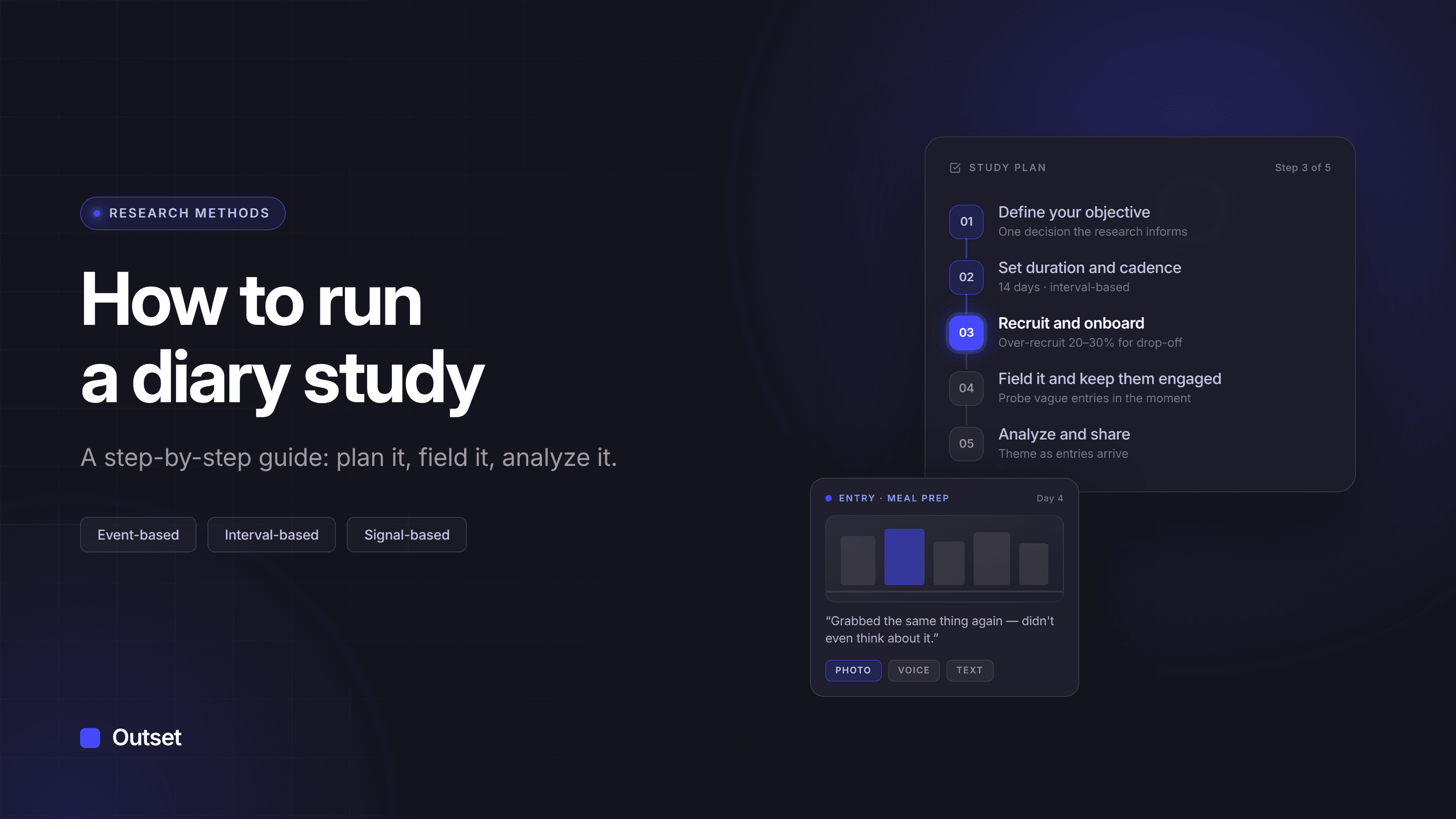
The platform also covers a wide range of methods in one place, including in-depth interviews (IDIs), concept tests, usability studies, and diary studies. With Visual Intelligence, the AI moderator can see screens, prototypes, and packaging, so participants can show as well as tell.
Enterprise teams get multi-layer governance, and Outset's trust and safety standards include SOC 2 Type II and GDPR compliance. Outset's research experts help design studies and drive adoption.
As human-led live interviews join AI-moderated studies in one platform, teams can plan the right moderator for every study without switching tools. Ready to see both methods in one workflow? Book Demo