Integrating human and AI-moderated interviews: Scaling research programs with the best of both
Jun 3, 2026

Integrating human and AI-moderated interviews: Scaling research programs with the best of both
AI-moderated interviews are automated qualitative research sessions where an artificial intelligence conducts voice or text conversations with participants, asking follow-up questions and adapting in real time to gather insights at scale. They sit between static surveys (which miss the "why") and traditional moderated interviews (which max out at however many sessions a human can run in a day).
Most teams don't actually need to choose between human and AI moderation—they need both, working together. This guide covers how AI-moderated interviews work, when each method fits best, and how to integrate them into a single research program that delivers depth and scale.
What is an AI-moderated interview
AI-moderated interviews are automated qualitative research sessions where an artificial intelligence conducts voice or text conversations with participants to gather insights at scale. The AI asks follow-up questions, clarifies responses in real time, and adapts based on what participants say—all without a human moderator present.
You can think of AI moderation as sitting between two familiar methods. Static surveys collect answers at scale but miss the "why" behind responses. Traditional moderated interviews capture rich context but max out at however many sessions a human can run in a day.
Participants receive an on-demand link and talk or type with the AI whenever it's convenient. No scheduling required. The platform then transcribes, summarizes, and extracts themes automatically.
How AI-moderated interviews work from guide to synthesis
1. Build the discussion guide
Researchers define core questions, learning objectives, and probing logic before a single interview runs. Many platforms offer AI-assisted guide creation to speed up setup, though the researcher controls moderator style, probing depth, and skip logic throughout.
The guide is the instrument. The AI executes it.
2. Recruit and screen participants
Recruitment integrates directly into the workflow. Participants can come from global panels—Outset connects to 25+ panels representing over 1.1 billion participants across 85+ countries—or from a team's own user base via shareable links.
After you recruit participants, built-in screeners with advanced logic filter them before they enter the study. AI-powered quality detection flags low-effort or fraudulent responses before analysis begins.
3. Run the live AI-moderated conversation
Participants access the study link and begin immediately. The AI conducts natural conversations via video, voice, or text—24/7, across time zones, without scheduling overhead.
Hundreds of interviews can run in parallel. What would take weeks with human moderators compresses into days or hours.
4. Probe with follow-ups and visual context
Here's where professional-grade platforms diverge from demo-grade tools. The AI asks dynamic follow-ups based on what it hears—and in platforms with Visual Intelligence, what it sees.
Visual Intelligence means the AI moderator can observe screens, prototypes, packaging, and physical environments, then probe on what it observes during the session. Outset's "Abyss mode" allows up to 10 layered follow-ups per question, pushing past surface-level answers.
5. Synthesize insights and share with stakeholders
The platform structures interviews into themes, evidence clusters, and traceable quotes automatically. Outputs include topline reports, highlight reels, and the ability to query data conversationally—asking questions like "What frustrated first-time users about onboarding?" and getting answers grounded in verbatim quotes.
Benefits of AI-moderated interviews for qualitative research at scale
Qualitative depth at survey scale
AI moderation generates richer open-ended data than static surveys while reaching hundreds of participants simultaneously.
Richer than surveys: Open-ended conversations surface the "why" behind answers
Consistent probing: Every participant gets the same depth of follow-up
Reduced social desirability bias: Some participants share more openly without a human present
Faster time to insight
Parallel interviews and instant synthesis compress timelines dramatically. Teams can move from questions to decisions without traditional bottlenecks. Microsoft used Outset to run research that contributed to a 5% increase in Copilot retention.
Multilingual reach across global audiences
AI-moderated interviews can run in 40+ languages simultaneously, enabling multi-market research without coordinating local moderators for each region.
Consistent moderation across every session
The AI follows the guide precisely, eliminating moderator variability. Every participant experiences the same probing logic, making cross-session comparison reliable and defensible.
When to use AI moderation versus human moderation
AI moderation is a distinct method, not a replacement for human-led research. The question isn't "which is better?" but "which fits this study?"
Scenario | Best fit |
|---|---|
Exploratory discovery, sensitive topics, executive interviews | Human moderation |
Scaling validated questions, multi-market studies, rapid concept testing | AI moderation |
Learning the problem space then validating at scale | Both in sequence |
When to lead with human-moderated interviews
Human moderators excel when the problem space is ambiguous, topics are sensitive, or you're interviewing high-stakes stakeholders like executives. They can pivot based on intuition and read non-verbal cues in ways AI cannot yet match.
Early-stage discovery work often benefits from human judgment—the ability to recognize when a throwaway comment deserves 15 minutes of follow-up.
When to scale with AI-moderated interviews
Once research questions are well-defined, AI moderation shines. Concept testing, persona validation, usability studies, and multi-language research all benefit from consistent probing at volume.
Away used Outset to conduct 75 interviews overnight with a team of one, exposing surprising behavior from 98% of shoppers.
When to run both methods together
The most effective research programs combine both. Human-led interviews for discovery, AI-moderated interviews to scale and validate. Professional platforms support both in one place, so findings don't fragment across tools.
How to integrate human and AI-moderated interviews in one research program
Step 1. Scope the problem with human-led discovery
Run a small number of human-moderated interviews to understand the problem space. Surface unexpected themes. Refine research questions. This is where intuition and improvisation matter most.
Step 2. Translate learnings into an AI-moderated discussion guide
Convert discovery insights into a structured guide with probing logic. AI guide-creation companions can help automate this translation, though the researcher remains in control of methodology.
Step 3. Scale the study with AI-moderated interviews
Launch the AI-moderated study to hundreds of participants simultaneously. The AI follows the guide, probes on what it hears and sees, and captures data in real time.
HubSpot ran 100+ interviews in days using this approach, shaping their AI roadmap based on what they learned.
Step 4. Synthesize human and AI sessions side by side
Analyze all sessions—human-led and AI-moderated—in one platform. This unified view prevents findings from fragmenting across tools and makes it easier to trace insights back to their source.
Research methods and use cases AI-moderated interviews support
In-depth interviews and persona research
AI conducts IDIs at scale to build or validate personas, capturing attitudes, motivations, and behavioral drivers across segments.
Concept and creative testing
Test messaging, positioning, packaging, or ad creative with visual stimuli. The AI can see and probe on what participants are reacting to—not just what they say about it.
Usability testing and UX evaluations
Participants share screens or interact with prototypes while the AI observes click paths and scrollmaps, asking contextual follow-ups based on what it sees—extending traditional usability testing with real-time probing.
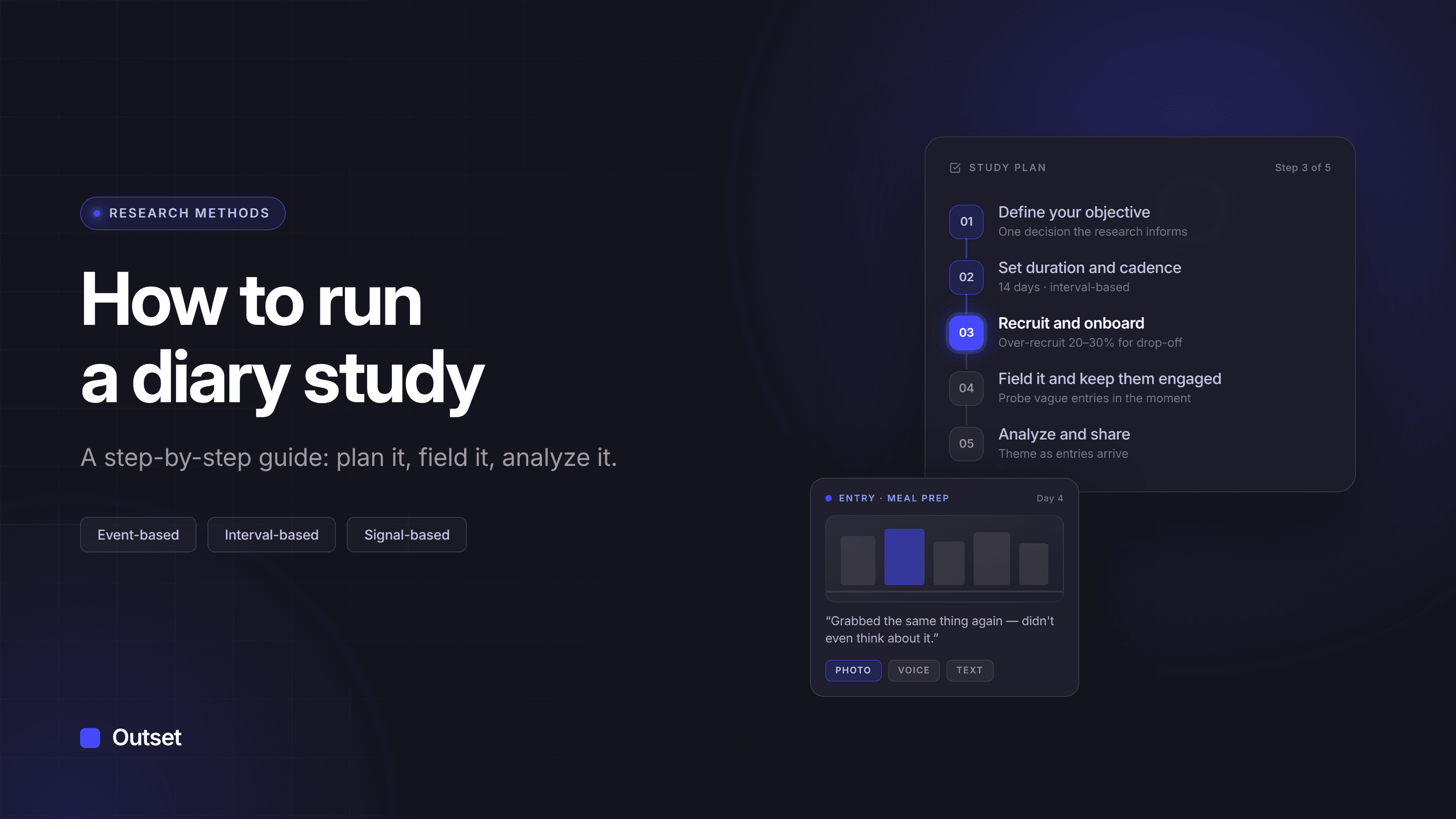
Diary studies and longitudinal research
Track participants across multiple rounds over days or weeks. Each round is a live AI-moderated conversation with real-time probing within the session—not a static form submission.
Shopalongs and in-home use tests
Participants walk through stores or use products at home while the AI moderator observes via video and probes on what it sees.
Limitations and methodological risks of AI-moderated interviews
AI moderation has real constraints worth understanding:
Nuance and non-verbal cues: AI may miss body language; platforms with Visual Intelligence and emotion analysis close this gap but don't eliminate it entirely
Participant drop-off: On-demand flexibility can lead to abandonment; clear expectations and engaging moderator design reduce this risk
Surface-level synthesis risk: Critics warn about reducing complex qualitative meaning into mechanical token counting; professional platforms link every insight back to verbatim quotes and evidence
Not a replacement for human judgment: AI moderation is a method, not a substitute for researcher expertise in study design and interpretation
Enterprise requirements for AI-moderated research
Researcher configurability of the AI moderator
The researcher controls the instrument—moderator style, probing depth, guide logic, analysis frameworks. The AI executes the researcher's methodology, not its own.
Visual intelligence for screens, prototypes, and physical products
Visual Intelligence means the AI moderator can see what participants see—screens, prototypes, packaging, shelves—and probe on what it observes in real time. This enables usability testing, concept testing, and shopalongs that static tools cannot support.
Participant recruiting and quality detection
Integrated recruitment from global panels and AI-powered fraud detection filter low-quality or fraudulent responses before they reach analysis. Outset's fraud detection tags 99%+ of problematic responses.
Security, compliance, and governance
Enterprise teams require SOC 2 Type II, GDPR, and HIPAA compliance. Multi-layer governance, data-segregated workspaces, and controls for large distributed teams make the difference between a demo and a platform built for ongoing programs.
Running integrated human and AI research in Outset
Outset supports human-moderated live interviews and AI-moderated interviews in the same platform. Researchers can recruit, schedule, moderate live conversations themselves, and analyze what they learn—alongside AI-moderated studies.
The workflow is straightforward: run human-led discovery to learn the problem space, then scale findings with AI-moderated interviews. All findings live in one place.
Four pillars make this work:
Researcher Configurability: You control the instrument
Breadth of Capability: IDIs, concept tests, usability, diary studies, and more in one platform
Enterprise Infrastructure: Governance and integrations for how large orgs actually operate
Human Partnership: Research experts who design studies and drive adoption
Test out a demo interview to experience the AI moderator firsthand.
Frequently asked questions about AI-moderated interviews
What is an AI-moderated interview?
An AI-moderated interview is an automated qualitative research session where an artificial intelligence conducts a voice or text conversation with a participant, asking follow-up questions and adapting in real time to gather insights at scale.
Are AI-moderated interviews a replacement for human researchers?
No—AI moderation is a distinct method that extends human research capacity, not a substitute for researcher expertise in study design, interpretation, and stakeholder communication.
How many AI-moderated interviews can run simultaneously?
AI-moderated platforms can conduct hundreds of interviews in parallel across time zones, compressing timelines that would take weeks with human moderators into days or hours.
Can AI-moderated interviews run in multiple languages at the same time?
Yes—professional platforms support dozens of languages simultaneously, enabling global multi-market research without coordinating separate moderators for each region.
How do AI-moderated interviews handle visual stimuli like prototypes or packaging?
Platforms with Visual Intelligence enable the AI moderator to see screens, prototypes, packaging, and physical environments, then probe on what it observes during the session.