Market Research Insights That Actually Drive Decisions
Jun 3, 2026

Market research insights reveal what customers do, what competitors charge, and how industries change—but the real value lies in explaining why those patterns exist and what to do about them. Without that interpretive layer, research produces interesting data that never influences a decision.
This guide covers how insights differ from raw findings, the methods that generate actionable evidence, and how AI is reshaping the speed and scale of market research without sacrificing depth.
What are market research insights
Market research insights reveal what customers do, what competitors charge, and how industries change. But here's the key distinction: an insight isn't just a number or a pattern. It's an interpretation that explains why something is happening and points toward a specific action.
A survey might tell you that 60% of respondents prefer Option A. That's a finding. An insight explains that respondents prefer Option A because it signals premium quality—which means positioning should emphasize craftsmanship, not price.
Strong insights answer three questions at once:
What is happening? The observable pattern in behavior or preference
Why is it happening? The underlying motivation or unmet need
What do we do about it? The recommended action based on evidence
When insights answer all three, they become decision-ready. When they stop at the first question, they're just data in a slide deck.
How insights differ from data and findings
Data, findings, and insights often get used interchangeably, but they represent different stages of understanding. Confusing them leads to reports that feel comprehensive yet leave stakeholders unsure what to do next.
Term | What it is | Example |
|---|---|---|
Data | Raw numbers or responses collected | 1,200 survey responses, 45 interview transcripts |
Finding | A pattern or observation in the data | 72% of users abandon checkout at the shipping step |
Insight | An interpretation that explains why and suggests action | Users abandon at shipping because unexpected costsUsers abandon at shipping because unexpected costs drive 48% of abandonments and feel like a bait-and-switch—display estimated shipping earlier to reduce drop-off |
Data is the raw material. Findings describe what the data shows. Insights explain what it means and point toward a specific move.
Why market research insights matter for business decisions
Insights reduce the cost of being wrong. Launching a product, repositioning a brand, or entering a new market without evidence is expensive—not just in dollars, but in time and organizational credibility.CB Insights found 42% of startups fail by building products nobody wants—costing not just dollars, but time and organizational credibility.
Teams that ground decisions in insights tend to move faster, not slower. When evidence is clear, debates shrink. Stakeholders align around what customers actually said rather than what the loudest voice in the room believes.
Product decisions: Validate concepts before committing development resources
Positioning and messaging: Ground brand strategy in language that resonates
Pricing: Understand willingness to pay before setting price points
Competitive response: Identify gaps competitors have missed
Without insights, teams rely on intuition. Intuition works sometimes, but itWithout insights, teams rely on intuition. According to Gartner, data-driven strategies outperform gut feelings in 65% of B2B sales organizations—intuition doesn't scale and it's hard to defend when results disappoint.
Types of market research insights
Not all insights answer the same question. Understanding the categories helps match the right method to the right business problem.
Customer and audience insights
Customer and audience insights reveal who buyers are, what motivates them, and how they make decisions. Teams often use them for segmentation, persona development, and targeting strategy.
Product and concept insights
Product and concept insights test whether a new idea, feature, or design resonates before anyone builds it. They're especially valuable early in development when changes are cheap.
Brand and positioning insights
Brand and positioning insights show how a brand is perceived relative to competitors and what associations it carries. They guide messaging, creative direction, and differentiation strategy.
Pricing and willingness-to-pay insights
Pricing insights uncover what customers expect to pay and how price affects perceived value. Getting pricing wrong can undermine even a strong product.
Competitive and category insights
Competitive insights map where rivals are strong or weak and how the category is shifting. They help teams spot opportunities before competitors do.
Behavioral and longitudinal insights
Behavioral insights track how actions change over time across multiple touchpoints or sessions. Diary studies and longitudinal research capture patterns that single-session methods miss.
Research methods that generate actionable insights
The method you choose shapes the insights you get. Broadly, research divides into primary (you collect it) versus secondary (someone else already did), and qualitative (depth and context) versus quantitative (scale and measurement).
AI-moderated interviews
An AI moderator conducts conversational interviews that probe in real time—asking follow-ups when answers are vague and adapting to what participants say. This approach delivers the depth of a traditional in-depth interview at the scale of a survey. Outset has conducted over 500,000 interview hours across 10,000+ studies, reaching participants in 85+ countries and 40+ languages.
Surveys and quantitative studies
Structured questionnaires measure attitudes, preferences, or behaviors at scale. They're useful for benchmarking and tracking, though they rarely explain why respondents answered the way they did.
Focus groups and in-depth interviews
Live conversations with a human moderator provide rich context and allow for spontaneous exploration. The trade-off is limited scale—most teams can only run a handful before time and budget run out.
Concept and creative testing
Participants react to prototypes, ads, or packaging before launch. This method catches perception gaps and messaging misfires early, when fixes are still affordable.
Usability and UX evaluations
Observing how users interact with a product or interface surfaces friction points that self-reported feedback often misses. Visual Intelligence—where the moderator can see screens, clicks, and facial reactions—adds another layer of evidence.
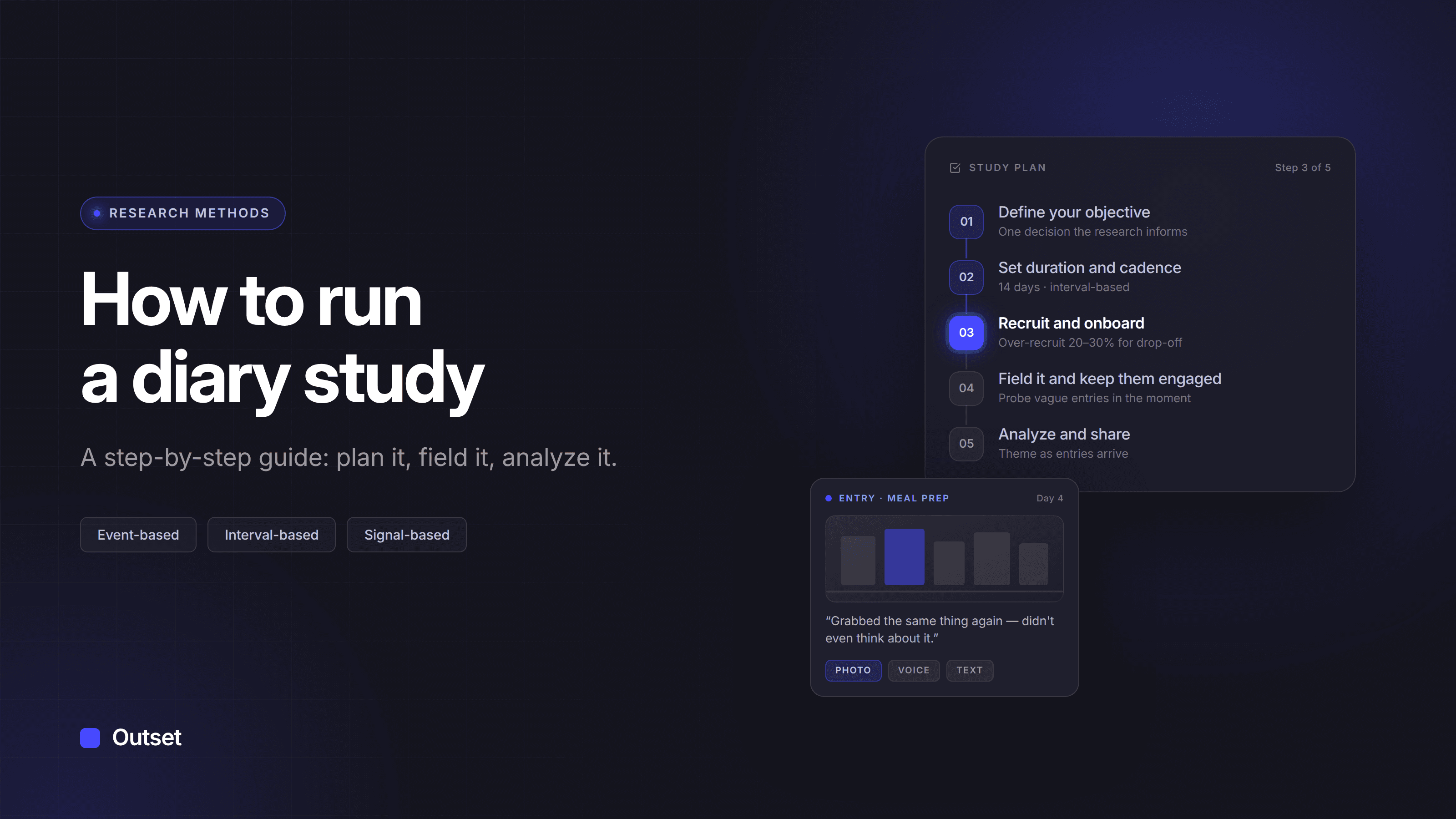
Diary studies and longitudinal research
Tracking the same participants over days or weeks captures behavior change that single-session methods can't detect. With Outset, every diary round is a live AI-moderated conversation that probes in real time, not just a form submission followed by async follow-up.
Desk research and secondary data
Analyzing existing reports, public data, and industry publications is faster and cheaper than primary research. The trade-off is that secondary data wasn't designed to answer your specific question.
The market research insights process
Generating insights follows a predictable workflow. Skipping steps—especially the first one—is the most common reason research fails to influence decisions.
1. Define the decision you need to make
Start with the business question, not the method. What will change based on what you learn? If you can't articulate the decision, the research will produce interesting data that sits unused.
2. Choose the right method and audience
Match the method to the question. Exploratory questions often call for qualitative depth; validation questions may benefit from quantitative scale. Then identify who can actually answer—existing customers, prospects, or a specific segment.
3. Recruit and field the study
Source participants from panels, your own user base, or integrated recruitment partners. Outset connects to 25+ global panels with access to over 1.1 billion participants, plus native integrations with Prolific, User Interviews, and Respondent.
4. Probe for depth in real time
Follow up on vague or surprising answers during the session—not after. This is where AI moderation changes the game: every participant gets consistent, adaptive probing without adding moderator headcount.
5. Synthesize across sessions
Identify patterns, themes, and contradictions. Link every theme back to specific participant quotes so stakeholders can trace the logic. Outset's synthesis tools generate topline reports and thematic summaries in minutes, with every claim traceable to raw evidence.
6. Translate findings into a decision
State the insight, the supporting evidence, and the recommended action. If the insight doesn't point to something someone will do differently, it's not finished.
How AI is changing market research insights
AI has compressed the timeline from weeks to hours for many research tasks. Teams that once waited two weeks for a synthesis report now get structured themes the same day interviews close.
Speed: Synthesis in minutes instead of weeks
Scale: Hundreds of interviews without adding headcount
Consistency: Every participant gets the same depth of probing
But speed without rigor creates new risks. Demo-grade tools often accept surface-level answers, generate summaries that sound plausible but lack grounding, or over-aggregate individual variation into generic themes.
The difference between professional-grade and demo-grade AI research comes down to control. With Outset, the researcher configures probing depth, guide logic, and analysis frameworks. The AI is the researcher's instrument—not the researcher.
Where AI market research works and where it falls short
AI-assisted insights are reliable in some contexts and risky in others. Knowing the difference helps teams avoid over-relying on automation.
Where AI excels:
High-volume exploratory research where patterns emerge across many sessions
Consistent follow-up probing that would exhaust a human moderator
Instant thematic synthesis with traceable quotes
Where human oversight matters:
Sensitive or emotionally complex topics that require judgment calls
Final interpretation and strategic framing for executive audiences
Validating AI-generated themes against raw evidence before presenting
The best approach treats AI as a force multiplier, not a replacement. Let the AI handle the heavy lifting of moderation and coding; reserve human judgment for interpretation and storytelling.
How to validate insight quality before presenting
Before sharing findings with stakeholders, run through a quick quality check. The following questions catch the most common failure modes.
Does the insight trace back to participant evidence
Every claim links to specific quotes or moments—not just an AI summary. If you can't show the evidence, the insight is an assertion, not a finding.
Is the sample representative of the decision audience
Check recruitment criteria and screening. Small or skewed samples limit how far you can generalize. A study of power users won't tell you how casual users behave.
Did the moderator probe on vague or contradictory answers
Surface-level answers produce surface-level insights. Confirm that follow-ups happened when participants gave one-word responses or contradicted themselves.
Are confidence levels visible for AI-generated claims
Professional-grade tools show certainty per finding, not just a headline accuracy stat. Outset displays confidence scores and traces every theme back to the words participants actually said.
Does the insight change what someone will do
If the finding doesn't point to an action, it's a data point, not an insight. Ask: "So what?" If you can't answer, keep digging.
What to look for in a market research insights platform
Choosing the right platform determines whether insights flow into decisions or stall in a backlog. Here's what separates professional-grade tools from demo-grade alternatives:
Researcher configurability: You control probing depth, guide logic, and analysis frameworks—the AI executes your methodology
Breadth of methods: IDIs, surveys, concept tests, usability, diary studies in one place
Enterprise infrastructure: Integrations, multi-layer governance, and data segregation for teams of 5 or 500
Human partnership: Access to research experts who help design studies, build integrations, and drive adoption
Traceability: Every synthesized insight links back to raw evidence
Outset was built for research programs, not one-off demos. SOC 2 Type II, GDPR, and HIPAA compliance come standard, along with 99%+ fraud-tagging accuracy to ensure you're analyzing authentic responses.
Turn market research insights into decisions with Outset
Outset combines AI-moderated interviews, Visual Intelligence, and instant synthesis in a single platform designed for professional researchers. Teams at Microsoft, HubSpot, Nestlé, and WeightWatchers use Outset to run rigorous studies at scale—without sacrificing depth for speed.
Book a demo to see how Outset fits your research program.
Frequently asked questions about market research insights
What is an insight in market research?
An insight is an interpretation of research data that explains why customers behave or feel a certain way and points toward a specific business action. It goes beyond describing what happened to recommend what to do next.
What are the five components of market research?
Common frameworks include defining objectives, choosing a method, collecting data, analyzing findings, and reporting actionable insights. The exact model varies by organization, but the sequence from question to action stays consistent.
Where can I get market research insights?
Insights come from primary research you conduct—surveys, interviews, usability tests—or secondary sources like industry reports and public data. Platforms like Outset combine recruitment, interviewing, and synthesis in one workflow to accelerate the process.
How do you write a market research insight?
State the observation, explain what it means for the customer, and recommend an action. Always link back to specific evidence from participants so stakeholders can trace your reasoning.
How is AI-moderated research different from a traditional survey?
AI-moderated research uses a conversational AI interviewer that asks follow-up questions in real time, producing qualitative depth at survey-like scale. Traditional surveys use fixed, static questions that can't adapt to what participants say.
How do enterprise teams keep AI-generated insights reliable?
Enterprise teams use platforms that show confidence scores per finding, trace every theme back to raw quotes, and layer human review before insights reach stakeholders. Governance controls and audit trails add another layer of accountability.