What Is Generative Research and Why Does It Matter
Jun 3, 2026

Generative research is an exploratory methodology used in the early stages of product development to deeply understand user behaviors, needs, and pain points before any design work begins. Unlike evaluative research that tests whether a solution works, generative research helps teams discover what problems are worth solving in the first place.
This guide covers when to use generative research, the most common methods, how to run a study from objective to synthesis, and how to scale depth without sacrificing quality.
What generative research means
Generative research is an exploratory methodology used in the early stages of product development to deeply understand user behaviors, needs, and pain points. Rather than testing whether a solution works, generative research helps teams discover what problems are worth solving in the first place.
You'll hear it called different names depending on who you're talking to:
Discovery research: finding unknowns before committing to a direction
Foundational research: building baseline understanding of users and markets
Exploratory research: open-ended inquiry without predetermined hypotheses
The word "generative" is doing real work here. This type of research generates understanding of who your customers are as humans—their motivations, frustrations, daily contexts—not just how they click through your product.
Core characteristics of generative research
Four traits distinguish generative research from other research types.
Exploratory and open-ended inquiry
Generative research starts without a solution in mind. The questions are designed to uncover unknowns rather than confirm what the team already believes. You're not asking "Does this feature work?" You're asking "What problems do people actually face?"
Qualitative and behavioral focus
Generative research prioritizes the "why" behind behaviors through rich, contextual data. Metrics tell you what happened. Generative research tells you why it happened and what it means for your product direction.
Upstream timing in the product lifecycle
Generative research happens at the very beginning, before any design or solution work. The goal is to define the right problem to solve—not to evaluate whether you solved it correctly.
Outputs that inform direction
Typical deliverables include user personas, journey maps, problem statements, and opportunity areas for innovation. These artifacts guide downstream decisions rather than measure outcomes.
Why generative research matters
Teams that skip generative research often build products that solve the wrong problem. Teams that skip generative research often build products that solve the wrong problem. The cost of that mistake compounds: wasted development cycles, costly pivots, and products that fail to resonate with users.
Generative research reveals what to build by uncovering unmet needs that competitors miss. It's the difference between guessing what customers want and actually knowing. When product teams invest in understanding problems before jumping to solutions, they make fewer expensive mistakes downstream.
When to use generative research
Generative research fits specific moments in the product lifecycle:
Entering a new market or category where existing assumptions don't apply
Launching a new product line and needing to understand unfamiliar users
Noticing declining engagement without a clear cause
Planning a major redesign and wanting to revisit foundational assumptions
Feeling that existing user knowledge has grown stale or untested
If you're running usability testing on a prototype, that's evaluative research. If you're trying to figure out what to prototype in the first place, that's generative.
Generative research vs evaluative research
Generative and evaluative research complement each other—they're not competing methodologies. Generative research answers "what problem are we solving?" while evaluative research answers "did we solve it well?"
Dimension | Generative research | Evaluative research |
|---|---|---|
Goal | Define the right problem | Test if the solution works |
Timing | Early/upstream | Mid-to-late/downstream |
Questions | Open-ended, exploratory | Specific, hypothesis-driven |
Outputs | Personas, journey maps, opportunities | Usability scores, task success rates |
Most mature research programs use both. Generative research informs what to design. Evaluative research validates whether the design succeeds.
Generative research methods and examples
Because generative research focuses on insight rather than measurement, it relies heavily on qualitative, human-centered methods. Here are the most common approaches.
In-depth interviews
Open-ended conversations about user habits and stories help researchers understand the "why" behind behaviors. This is the most common generative method—and often the most revealing. A single 45-minute interview can surface insights that weeks of survey data miss.
Ethnographic and field studies
Studying users in their natural environments captures context that surveys miss entirely. You see how people actually navigate real-world problems, not just how they describe doing so. The gap between what people say and what people do often holds the most valuable insights.
Diary studies
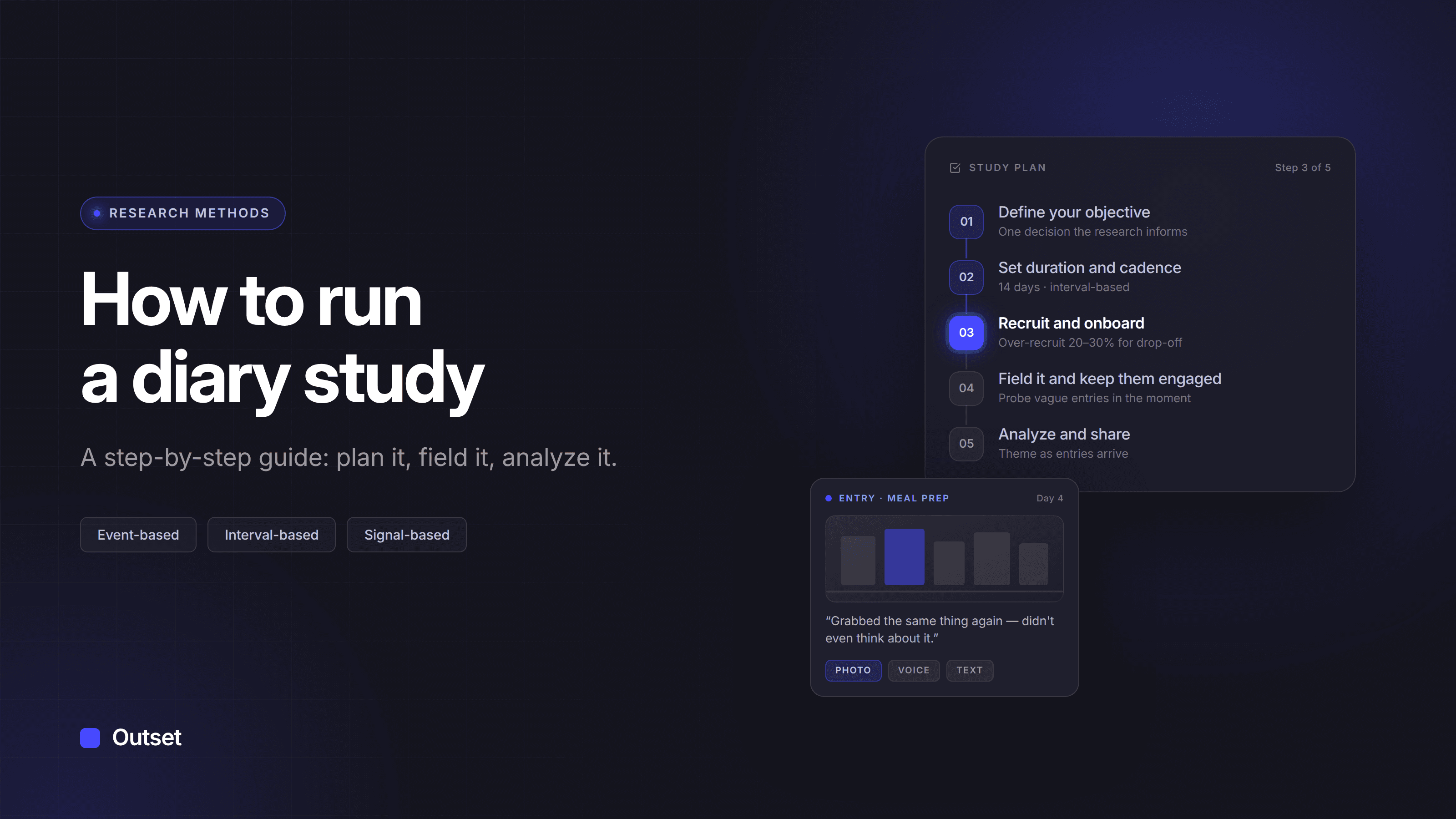
Participants track daily activities and frustrations over days or weeks. Diary studies capture real-world behaviors and emotions over time, revealing patterns that a single interview might miss. They're particularly useful for understanding habits, routines, and pain points that unfold gradually.
Contextual inquiry and shopalongs
Observing and interviewing users while they perform tasks in real environments—retail stores, homes, workplaces—provides rich behavioral data alongside verbal responses. You're watching someone do the thing, not just hearing them describe it later.
Open-ended surveys
Surveys with open text responses let participants share thoughts in their own words. While less common for generative work, they're useful for broad exploration at scale when you want to cast a wide net before diving deeper.
Concept exploration and co-creation
Early-stage ideation with users generates new ideas together rather than testing existing ones. Participants become collaborators in defining what's possible, often surfacing directions the team hadn't considered.
How to run a generative research study
If you're new to generative research, here's a practical sequence to follow.
1. Define the research objective
Start by articulating what you want to learn and why. Focus on understanding problems rather than validating solutions. A good objective might be: "Understand how first-time homebuyers navigate mortgage decisions." A weak objective: "Test whether users like our new mortgage calculator."
2. Recruit the right participants
Identify people with the experiences and perspectives most relevant to your research questions. Diversity matters here—varied participants reveal varied needs. Homogeneous samples produce blind spots.
3. Design the discussion guide
Use open-ended questions that invite storytelling. Avoid leading language or solution-focused framing. Instead of "Would you use a feature that does X?" try "Tell me about the last time you faced this challenge."
4. Conduct the interviews
Build rapport, listen actively, and probe deeper with follow-ups. The goal is to understand the participant's world, not confirm the team's assumptions. When someone says something unexpected, that's often where the real insight lives.
5. Synthesize the findings
Look for patterns across sessions using affinity mapping or thematic analysis. Transform raw data into insights and opportunity areas that teams can act on. This step is where scattered observations become coherent direction.
6. Share insights and opportunities
Translate findings into actionable recommendations, personas, or "how might we" statements. The best generative research doesn't just describe problems—it points toward solutions worth pursuing.
Best practices for high-quality generative research
A few practices separate adequate generative research from genuinely useful generative research.
Ask open questions free of bias
Questions that invite stories yield richer data than yes/no framing. "Tell me about a time when..." opens doors that "Do you ever..." closes. The phrasing of your questions shapes the quality of your data.
Probe on what you hear and see
The richest insights come from going deeper rather than moving on too quickly. When a participant says something unexpected, follow up. Ask "Tell me more about that" or "What did you mean when you said...?"
Observe behavior alongside words
What people do often differs from what they say. Visual and behavioral cues—facial expressions, hesitations, workarounds—add critical context that transcripts alone miss.
Recruit for diversity and fit
Balance participants who match your target audience with diverse perspectives that reveal edge cases. If everyone you interview looks and thinks the same way, you'll miss important variations in how people experience problems.
Synthesize continuously, not just at the end
Debrief after each session to capture fresh impressions. Patterns emerge faster with ongoing synthesis, and you can adjust your guide as you learn. Waiting until all interviews are complete means losing nuance along the way.
How to scale generative research without losing depth
Here's the core tension researchers face: generative research is traditionally slow and expensive because it requires skilled human moderation. Running 50 in-depth interviews with a human moderator takes weeks and significant budget. Most teams end up running fewer interviews than they'd like, which limits the patterns they can detect.
AI-moderated interviews offer a way forward. An AI moderator can conduct natural, adaptive conversations at scale while maintaining probing depth—asking dynamic follow-ups and adapting to participant responses rather than mechanically moving through a script.
The key distinction is whether the AI follows the researcher's methodology or imposes its own. When researchers control the instrument—moderator style, probing depth, guide logic—they can run more interviews in parallel without sacrificing the exploratory quality that makes generative research valuable.
Running generative research at program scale with Outset
Outset is the professional-grade platform for AI-moderated research, built for the rigor and complexity that real generative research demands. The AI interviewer conducts natural conversations with dynamic follow-ups—including up to 10 layers of probing per question—while researchers control moderator style, probing depth, and guide logic.
Instant synthesis transforms interviews into actionable insights. Visual Intelligence lets the AI moderator observe behavior alongside words: screens, prototypes, facial expressions, and real-world interactions. With access to 1.1B+ participants across 85+ countries and enterprise-grade security (SOC 2 Type II, GDPR, HIPAA), teams at Microsoft, HubSpot, and Nestlé run generative research programs at scale without adding headcount.
Explore how Outset can power your generative research →
FAQs about generative research
What is an example of generative research?
A product team conducting in-depth interviews with potential customers to understand their daily frustrations before designing a new app is practicing generative research. The goal is to uncover unmet needs, not test an existing solution.
Is generative research the same as discovery research?
Yes. Generative research and discovery research are synonymous terms. Both refer to exploratory research conducted early in the product lifecycle to understand user needs and define problems worth solving.
How many participants are typically needed for generative research?
Generative research typically involves smaller sample sizes than quantitative studies because the goal is depth, not statistical significance. Most teams conduct between 8 and 15 in-depth interviews to reach thematic saturation—the point where new interviews stop revealing new patterns.
Can AI moderate generative research interviews?
Yes. AI-moderated interviews can conduct generative research by asking open-ended questions and dynamic follow-ups that adapt to participant responses. The key is ensuring the AI moderator probes deeply rather than moving through questions mechanically.